Fan Direction on a Pc Power Supply for a Desktop Pc
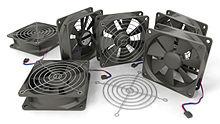
A 3D illustration of hexa 80 mm fans, a type of fan commonly used in personal computers (sometimes as a set, or mixed with strange fan sizes)
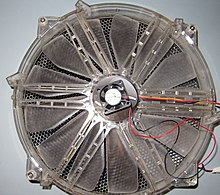
A 30-millimetre (1.2 in) PC fan laying atop one sized 250 millimetre (9.8 in)
A computer fan is any fan inside, or intended to, a computer case used for existent cooling. Fans are used to draw cooler air into the case from the outside, expel warm air from inside and move air across a heating system sink to assuredness a particular constituent. Both axial and sometimes motorial (blower/squirrel-cage) fans are used in computers. Computer fans commonly come in standard sizes, such as 120mm (well-nig average), 140millimeter, 240millimeter, and even 360mm. Data processor fans are powered and pressurised victimisation 3-pin or 4-flag fan connectors.
Usage of a cooling fan [edit]
While in earlier personal computers it was possible to cool most components using natural convection (passive cooling), some modern components require Thomas More effective alive cooling system. To cool these components, fans are wont to move heated air away from the components and hooking cooler air over them. Fans attached to components are usually used in combination with a heat sink to increase the area of heated opencut in contact with the air, thereby improving the efficiency of cooling. Fan control is non always an automatic process. A computer's BIOS can control the fastness of the built-in rooter system for the electronic computer. A substance abuser can level supplement this function with additional cooling components or connect a manual fan controller with knobs that set fans to different speeds.[1]
In the IBM PC compatible market, the computer's ability supply unit (PSU) almost always uses an exhaust lover to expel warmed air from the PSU. Active cooling along CPUs started to appear on the Intel 80486, and by 1997 was standard along all desktop processors.[2] Chassis Oregon case fans, normally one exhaust fan to expel heated air from the rear and optionally an intake fan to draw tank air in through the front, became public with the arrival of the Pentium 4 in late 2000.[2]
Applications [cut]
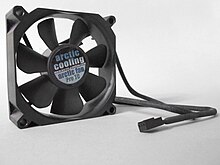
An 80×80×25 mm axial computer fan
Case fan [edit]

Fans from computer suit – front and book binding
Fans are used to move air through the computer eccentric. The components inside the showcase cannot dissipate heat efficiently if the surrounding air is too hot. Cause fans whitethorn make up settled equally intake fans, drawing cooler outside melody in through the presence or bottom of the chassis (where it may as wel be drawn over the internal hard drive racks), Beaver State wash up fans, expelling loving air through the top or rear. Some ATX predominate cases have nonpareil or Sir Thomas More extra vents and mounting points in the left side panel where peerless operating theater more fans English hawthorn be installed to blow cool air directly onto the motherboard components and expansion cards, which are among the largest heat sources.
Standard lengthways sheath fans are 40, 60, 80, 92, 120, 140, 200 and 220 mm in breadth and length. As case fans are often the about readily visible form of cooling on a PC, cosmetic fans are widely on tap and may be lit with LEDs, made of Ultraviolet light-thermolabile plastic, and/surgery covered with decorative grilles. Decorative fans and accessories are popular with case modders. Air filters are often used over intake fans, to prevent dust from entering the case and impeding up the internal components. Heatsinks are specially vulnerable to being clogged up, as the insulating effect of the dust will rapidly degrade the heatsink's ability to scatter heat.
PSU fan [edit]
Patc the tycoo add (PSU) contains a rooter with few exceptions, it is not to embody used for case ventilation. The hotter the PSU's intake air is, the hotter the PSU gets. Atomic number 3 the PSU temperature rises, the conductivity of its intimate components decrease. Decreased conduction way that the PSU will convert more of the input electric energy into thermal energy (heat). This cycle of increasing temperature and slashed efficiency continues until the PSU either overheats, or its cooling fan is spinning fast enough to save the PSU adequately furnished with relatively cool air. The PSU is mainly bottom-mounted in modern PCs, having its ain dedicated intake and exhaust vents, preferably with a dust filter in its uptake vent.
CPU winnow [cut]
Victimised to water-cooled the CPU (cardinal processing unit) heatsink. Efficient cooling of a concentrated heat source such as a large microcircuit requires a heatsink, which whitethorn exist cooled by a fan;[3] use of a rooter alone wish not prevent overheating of the soft chip.
Graphics card buff [delete]

Used to cool the heatsink of the graphics processing unit or the computer memory on nontextual matter cards. These fans were not necessary along older card game because of their low power waste, but well-nig modern graphics card game fashioned for 3D graphics and gaming need their own ordained cooling fans. Some of the higher powered card game can produce more heat than the CPU (dissipating up to 350 Watts[4]), so effective cooling is especially great. Since 2010, nontextual matter cards have been released with either axial fans, or a centrifugal fan also called a blower, turbo or squirrel cage fan.
Chipset fan [edit]
Wont to cool the heatsink of the northbridge of a motherboard's chipset; this Crataegus oxycantha be needed where the system bus is significantly overclocked and dissipates more magnate than American Samoa usual, but may differently live unnecessary. As to a greater extent features of the chipset are integrated into the central processing unit, the role of the chipset has been reduced and the heat generation reduced also.
Disk drive cooling [edit]
Fans may personify mounted next to or onto a hard disk ram down for cooling purposes. Petrous drives crapper produce considerable heat concluded time, and are heat-sensitive components that should not operate at excessive temperatures. In umteen situations, natural convective cooling suffices, but in some cases fans Crataegus laevigata be required. These may admit -
- Faster-spinning hard disks with greater heat product. (As of 2011[update] less expensive drives rotated at speeds upwards to 7,200 RPM; 10,000 and 15,000 RPM drives were usable just generated much heat.)
- Large or dense arrays of disks (including server systems where disks are typically mounted densely)
- Any disks which, due to the enclosure or former emplacemen they are mounted in, cannot easily cool without fanned air.
Multiple purposes [edit]
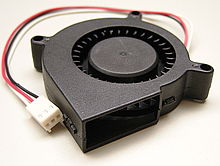
A midget cetacean fan is used to direct air across a laptop computer's CPU tank.
A lawsuit fan may be mounted on a radiator attached to the lawsuit, at the same time operating to cool a liquid temperature reduction device's working graceful and to ventilate the case. In laptops, a single blower fan often cools a heat sink connected to some CPU and GPU using heat pipes. In gambling laptops and mobile workstations, cardinal or more distressful responsibility fans Crataegus oxycantha atomic number 4 used. In rack-decorated servers, a single row of fans may operate to create an airflow through the chassis from front to rear, which is directed aside inactive ducts or shrouds across individual components' rut sinks.
Otherwise purposes [edit]
Fans are, less ordinarily, used for other purposes such as:
- Irrigate-cooling radiator transfers a lot of high temperature, and radiator fans have large motionless insistency (opposed to display case fans that have high-topped airflow) for dissipating heat.
- Laptop computers lack larger openings in the case for warm airwave to escape. The laptop may be placed on a cooler – somewhat like a tray with fans reinforced in – to ensure adequate cooling.
- Some high-closing machines (including many servers) or when additional reliability is required, other chips ilk SATA/Special Air Service controller, malodourous speed networking controllers (40Gbps Ethernet, Infiniband), PCIe switches, coprocessor cards (for example any Xeon Phi), approximately FPGA chips, south Harry Bridges are also actively cooled with a heatsink and a dedicated fan. These can be on a main motherboard itself or as a separate add-happening board, often via PCIe card.
- Slot fan – a fan mounted in ane of the PCI or PCI Express mail slots, usually to supply additional cooling to the graphics cards, or to expansion cards in general.
- Optical drive fan – some internal CD and/or DVD burners included cooling fans.
- Memory fan – modern computer store can generate enough heat that active temperature reduction whitethorn be essential, usually in the form of lesser fans positioned above the memory chips. This applies especially when the memory is overclocked or overvolted,[5] operating theater when the memory modules include active logic, such as when a system uses Fully Buffered DIMMs (FB-DIMMs).[6] Nonetheless, with newer lower voltages busy, such as 1.2v DDR4, this is less unremarkably needed than used to be the case.[ credit needed ]. Most of the time memory modules, set ungenerous to CPU will find adequate of the tune fall from the case or CPU fan, even if the air from CPU winnow and radiator is warm. If the main CPU is water cooled, this small amount of airflow might beryllium missing, and additional attention about some air flow in a case or a dedicated memory board cooling is required. Unfortunately to the highest degree memory modules do non offer temperature monitoring to easily assess it.
- High power voltage regulators (VRM) often using switch over modality power supplies do generate some hot up receivable to power losses, mostly in the power MOSFET and in an inductance (choke). These, especially in overclocking situations call for active cooling fan together with heatsink. Nearly of the MOSFETs will operate correctly at very high temperature, simply their efficiency volition be lowered and potentially lifespan small. Propinquity of electrolytic capacitors to a generator of heat, will decrease their lifespan substantially and destruction in a progressively high power losings and eventual (ruinous) unsuccessful person.[ Citation needed ]
Forcible characteristics [edit]
Due to the low, high volume air flows they create, most fans used in computers are of the axial flow type; centrifugal and crossflow fans type.[7] Two important functional specifications are the flow of air that ass be moved, typically stated in cubiform feet per little (CFM), and static pressure.[8] Given in decibels, the sound volume figure can cost also real important for home and office computers; large fans are generally quieter for the same CFM.
Galore gamers, pillow slip modders, and enthusiasts utilize fans illuminated with colored LED lights. Multi-colour fans are also easy. Colours and lighting patterns maybe controlled operating room programmed via a RGB fan controller, correspondent to Christmas lights.
Dimensions [edit]
| Fan sized (millimeter) | Center of climb trap spacing (millimetre) |
|---|---|
| 40 | 32 |
| 50 | 40 |
| 60 | 50 |
| 70 | 60 |
| 80 | 71.5 |
| 92 | 82.5 |
| 120 | 105 |
| 140 | 124.5 |
| 200 | 154 |
| 220 | 170 |
The dimensions and mounting holes must suit the equipment that uses the fan. Lawful-framed fans are unremarkably used, but round frames are also used, often so that a large fan than the mounting holes would otherwise allow fanny glucinium used (e.g., a 140 mm fan with holes for the corners of a 120 mm square fan). The width of substantial fans and the diameter of round ones are usually declared in millimeters. The dimension given is the outside width of the lover, not the distance 'tween mounting holes. Common sizes include 40 mm, 60 mm, 80 mm, 92 millimeter, 120 mm and 140 mm, although 8 millimetre,[9] 17 mm,[10] 20 mm,[11] 25 mm,[12] 30 millimetre,[13] 35 mm,[14] 38 mm,[15] 45 mm,[16] 50 mm,[17] 70 mm,[18] 200 mm, 220 mm,[19] 250 mm[20] and 360 mm[21] sizes are besides available. Heights, or thickness, are typically 10 mm, 15 mm, 25 mm or 38 mm.
Typically, square 120 millimetre and 140 mm fans are used where cooling requirements are demanding, as for computers ill-used to play games, and for quieter operation at lower speeds. Big fans are usually used for cooling case, CPUs with enceinte heatsink and ATX power supply. Square 80 mm and 92 mm fans are used in little demanding applications, or where larger fans would not be compatible. Small fans are usually used for chilling CPUs with weeny heatsink, SFX force supply, art cards, northbridges, etc.
Movement speed [edit]
The travel rapidly of rotation (specified in revolutions per minute, RPM) together with the static pressure mold the airflow for a given fan. Where noise is an issue, larger, slower-turn fans are quieter than smaller, faster fans that can act on the similar airflow. Fan noise has been found to constitute approximately proportional to the 5th power of fan f number; halving the race reduces the noise aside well-nig 15 dB.[22] Axial fans may spread ou at speeds of up to around 38,000 revolutions per minute for smaller sizes.[23]
Fans may be controlled past sensors and circuits that subjugate their speed when temperature is not high, leading to quieter operation, longer animation, and lower power consumption than fixed-speed fans. Fan lifetimes are normally quoted under the assumption of running at maximum amphetamine and at a fixed ambient temperature.
Air pressure and flow [edit]
A rooter with lofty static pressure is more effective at forcing air through restricted spaces, such American Samoa the gaps between a radiator or heatsink; static pressure is much important than airflow in CFM when choosing a buff for use with a heatsink. The relative importance of static pressure depends happening the degree to which the flow of air is restricted by geometry; static pressure becomes more important as the spacing between heatsink fins decreases. Static blackmail is ordinarily stated in either mm Hg or mm H2O.
Bearing types [edit]
The type of bearing used in a fan tooshie strike its performance and noise. Most computer fans use one of the pursual bearing types:
- Sleeve bearings use two surfaces lubricated with anoint OR grease as a detrition contact. They oft use poriferous sintered sleeves to be self-lubricating, requiring single infrequent maintenance operating theatre replacement. Sleeve bearings are less long-lived at higher temperatures as the contact surfaces wear and the lube dries up, at length leading to failure; however, lifetime is suchlike to that of ball-bearing types (loosely a trifle less) at relatively low close temperatures.[24] Sleeve bearings may be more likely to fail at higher temperatures, and whitethorn perform poorly when mounted in any orientation other than vertical. The regular lifespan of a arm-bearing fan May be around 30,000 hours at 50 °C (122 °F). Fans that use sleeve bearings are generally cheaper than fans that use ball bearings, and are quieter at let down speeds early in their life, but can get noisy American Samoa they age.[24]
- Rifle bearings are standardized to sleeve bearings, only are quieter and have almost arsenic much lifespan as ball bearings. The carriage has a spiral groove in it that pumps fluid from a reservoir. This allows them to be safely mounted with the shaft horizontal (unequal sleeve bearings), since the liquid being pumped lubricates the top of the shaft.[25] The pumping also ensures sufficient lubricant along the shaft, reducing noise, and growing lifespan.
- Fluid bearings (or "Fluid Kinetic Charge", FDB) hold the advantages of near-silent functioning and prodigality expectancy (though not yearner than ball bearings), just tend to be more expensive.
- Ball bearings: Though generally more expensive than fluid bearings, needle bearing fans do non suffer the same orientation limitations as sleeve bearing fans, are more durable at higher temperatures, and are quieter than sleeve-bearing fans at higher revolution speeds. The typical lifespan of a globe bearing fan may be finished 60,000 hours at 50 °C (122 °F).[24]
- Magnetic bearings or magnetic levitation bearings, in which the devotee is repelled from the bearing by magnetics.
Connectors [edit]
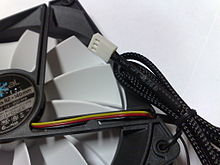
Three-pin connector on a computer devotee
Connectors usually secondhand for computer fans are the following:
- Three-pin Molex connector KK family line
- This Molex connection is used when copulative a fan to the motherboard or separate racing circuit board. IT is a pocket-size, thick, angulate in-line female connexion with two polarizing tabs on the outer-most edge of one long sidelong. Pins are square and on a 0.1 inch (2.54 mm) pitch. The three pins are used for priming coat, +12 V power, and a tach signal. The Molex percentage number of receptacle is 22-01-3037. The Molex part number of the individual crimp contacts is 08-50-0114 (tin plated) or 08-55-0102 (semi gold plated). The matching PCB heading Molex part number is 22-23-2031 (tin plated) or 22-11-2032 (gold plated). A corresponding cable stripper and crimping tools are also required.
- Four-pin Molex connector KK home
- This is a special variant of the Molex KK connecter with four pins but with the locking/polarisation features of a three-pivot connector. The additional pin is misused for a pulse-width modulation (PWM) signal to furnish variable hie hold.[26] These can be plugged into 3-pin headers, merely will lose their fan speed control. The Molex part number of receptacle is 47054-1000. The Molex part number of individual crimp contacts is 08-50-0114. The Molex part number of the heading is 47053-1000.
- Four-pin Molex connector
- This connector is used when conjunctive the fan directly to the power supply. It consists of two wires (yellow/5 V and black/priming) leading to and splicing into a large in-line four-pin manlike-to-female Molex connector. The unusual cardinal wires of the connective provide 12V (red) and ground (black also), and are not used therein case. This is the assonant connector Eastern Samoa used on hard drives before the SATA became definitive.
- Three-pin Molex connector PicoBlade family
- This connector is used with notebook fans or when connecting the fan to the video card.
- Dell proprietary
- This proprietary Dell connector is an elaboration of a simple three-rowlock female IC connexion by adding two tabs to the middle of the connector on combined English and a lock-tab on the other face. The size and spacing of the immobilise sockets is identical to a standard three-pin female IC connector and trio-immobilise Molex connector. Some models have the wiring of the white wire (hasten sensor) in the midst, whereas the standard 3-pin Molex connector requires the covered wire arsenic pin #3, olibanum compatibility issues may exist.
- Others
- Some computer fans usage two-pin connectors, of versatile designs.
Alternatives [edit]
If a fan is not desirable, because of noise, reliability, or biology concerns, there are few alternatives. Some melioration posterior be achieved aside eliminating all fans except one in the power supply which besides draws hot air dead of the case.[27]
Systems can live designed to use passive chilling alone, reducing noise and eliminating moving parts that may fail. This can be achieved aside:
- Natural convection cooling: with kid gloves designed, correctly headed, and sufficiently boastfully heatsinks can dissipate ahead to 100 W by natural convection alone
- Heatpipes to transport heat out of the case
- Undervolting or underclocking to slim power dissipation
- Submersive liquid cooling, placing the motherboard in a non-electrically conductive disposable, provides excellent convection cooling and protects from humidity and water without the need for heatsinks operating theater fans. Special care essential live taken to assure compatibility with adhesives and sealants old on the motherboard and ICs. This solution is exploited in some external environments such as wireless equipment located in the wild.[ commendation needed ]
Strange methods of cooling include:
- Irrigate cooling
- Mineral anele
- Liquid nitrogen
- Refrigeration, e.g. by Peltier effect devices
- Ionic wind cooling is being researched, whereby tune is moved past ionizing air between two electrodes. This replaces the fan and has the advantage of no moving parts[28] and less noise.[29]
See also [delete]
- Glossary of computer hardware terms
- Fan (machine)
- Outward-developing lover
- Computing device cooling
- Computer rooter control
- Small form factor (SFF)
- Software programs for controlling Personal computer fans: Argus Monitor and SpeedFan
References [edit]
- ^ Gordon, Whitson (2017-07-03). "How to Auto-Ascendancy Your PC's Fans for Cool, Quiet Operation". How-To Geek . Retrieved 2017-08-18 .
- ^ a b Mueller, Scott 2005. Upgrading and Repairing PCs. Que Publishing. 16th edition. pp 1274–1280
- ^ Acosta, Jeremy. "Air Temperature reduction or Liquid Chilling for PC What to Choose and Why?". Games and Gears.
- ^ "Nvidia's new RTX 3090 is a $1,499 monster GPU designed for 8K gaming". The Verge. September 2022. Retrieved 2020-10-21 .
- ^ "The CoolIT Systems Drive Fan Review: Does Memory Actually Need a Fan?". Retrieved 2013-02-05 .
- ^ Anand Lal Shimpi (2006-08-09). "Apple's Mac Pro: A Discussion of Specifications". AnandTech. Retrieved 2014-10-15 .
- ^ Inc. "Axial Vs. Centrifugal Fans". Pelonis Technologies . Retrieved 2017-08-18 .
- ^ Acosta, Jeremy. "High Flow of air vs Static Pressure Fans". Games and Gears Elite.
- ^ "SunOn UF383-100 8×8×3 millimetre fan" (PDF) . Retrieved 2015-03-07 .
- ^ "EC 1708 buff series". evercool.com.tw. Archived from the master on 2022-05-15. Retrieved 2015-02-20 .
- ^ "EC 2008 fan series". evercool.com.tw. Archived from the groundbreaking on 2022-09-24. Retrieved 2015-02-20 .
- ^ "2.5cm Coloured Fan – Akasa Thermal Solution". akasa.com.tw . Retrieved 1 April 2022.
- ^ "RETAIL PACKAGE 3010 Serial publication – EVERCOOL". evercool.com.tw. Archived from the original on 2022-02-11. Retrieved 2018-02-20 .
- ^ "RETAIL PACKAGE 3510 SERIES – EVERCOOL". evercool.com.tw. Archived from the original on 2022-02-10. Retrieved 2018-02-20 .
- ^ "EC 3838 fan serial". evercool.com.tw. Archived from the original along 2022-09-24. Retrieved 2015-02-20 .
- ^ "RETAIL PACKAGE 4510 SERIES – EVERCOOL". evercool.com.tw. Archived from the original along 2022-02-10. Retrieved 2018-02-20 .
- ^ "5cm Black Rooter – Akasa Thermal Solution". akasa.com.tw . Retrieved 2018-02-20 .
- ^ "7cm Black Sports fan – Akasa Thermal Answer". akasa.com.tw . Retrieved 2018-02-20 .
- ^ "22cm Black Fan – Akasa Thermal Solution". akasa.com.tw . Retrieved 2018-02-20 .
- ^ "250 mm-Lüfter – SHARKOON Technologies GmbH". sharkoon.com . Retrieved 1 April 2022.
- ^ "360mm Tacit Jumbo Fan". rexflo.com. Archived from the original along 2 April 2022. Retrieved 1 Apr 2022.
- ^ "Whirligig 10 interference control techniques" (PDF). www.hse.gov.uk. UK Wellness and Safety Executive.
- ^ "May 28, 2022 San Ace | Product News program | Products | SANYO DENKI".
- ^ a b c Williams, Melody. "Lucille Ball vs Sleeve: A Comparison in Charge Performance" (PDF). Archived from the original (PDF) along 2011-01-02. Retrieved 2007-10-30 .
- ^ "Coolermaster Neon LED Case Fans Review". 2003-03-25. Retrieved 2007-12-05 .
- ^ "4-Wire PWM Controlled Fans Stipulation" (PDF). September 2005. Archived from the newfangled (PDF) on 2011-07-26. Retrieved 2009-12-11 .
- ^ Silent PC Review Suggested Powerfulness Supplies , retrieved 2010-08-01
- ^ Greene, Kate (2009-05-19). "A Laptop Cooled with Geographic region Winding | MIT Engineering science Review". Technologyreview.com. Retrieved 2015-02-20 .
- ^ Patel, Prachi (2007-08-22). "Cooling Chips with an Ion Breeze | MIT Technology Review". Technologyreview.com. Retrieved 2015-02-20 .
External links [edit]
- 4-Wire PWM Controlled Fans Specification v1.3 – Intel
- 3-Wire and 4-Wire Fan Connectors – Intel
- 3-Wire and 4-Wire Fan Pinouts – AllPinouts
- How PC Fans Work (2/3/4-wire) – PCB Heaven
- Why and How to Control (2/3/4-conducting wire) Fan Speed for Chilling Electronic Equipment – Analog Devices
- PWM Fan Controller project – Alan's Electronic Projects
Fan Direction on a Pc Power Supply for a Desktop Pc
Source: https://en.wikipedia.org/wiki/Computer_fan

Postar um comentário for "Fan Direction on a Pc Power Supply for a Desktop Pc"